
Whether Transparent LED Film Support Splicing and Expansion
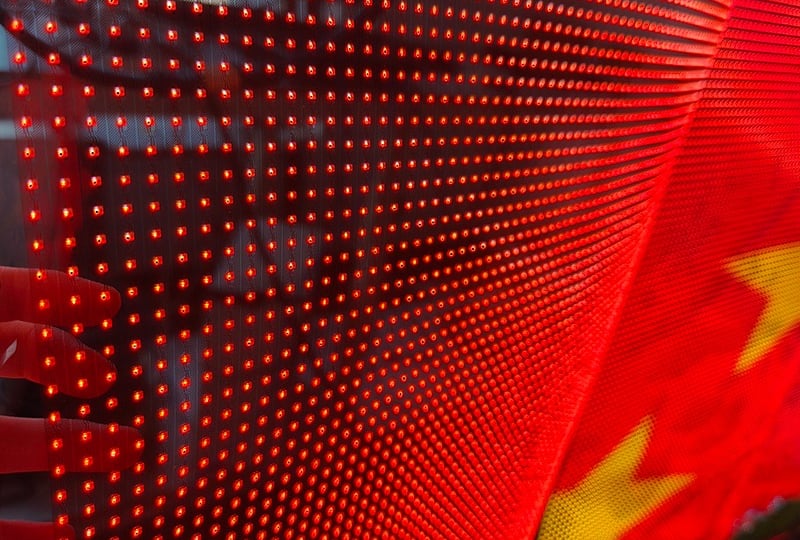
In commercial displays and glass curtain wall advertising applications, a key consideration during the selection phase is whether transparent led film support splicing and expansion. Since a single screen often cannot meet the requirements of large display windows or entire curtain walls, the ability to splice directly impacts image integrity and project feasibility. LED flexible film screens themselves are made of flexible substrates and feature a micro-LED packaging structure, offering certain cutting and splicing characteristics, with expansion needs already considered in their design.
In terms of structural form, transparent led film are typically supplied as modules or rolls. Individual modules are connected in series using dedicated cables and signal interfaces, with a control system driving each unit uniformly. For larger projects, splicing can be carried out in a matrix layout both horizontally and vertically. During splicing, it is essential to ensure stable signal transmission and proper power distribution to avoid brightness inconsistencies caused by voltage drops.
In glass curtain wall applications, splicing and expansion of LED flexible film screens require attention to consistency in transparency. Products from different batches should maintain uniform parameters to ensure a smooth transition in display quality. The control system supports zone-based calibration, helping to reduce brightness differences at the seams. For irregular structures, such as curved display windows or column cladding, cutting and splicing can be used to achieve a curved fit.
The ability to splice and expand is also closely related to the installation method. For glass-side adhesive installations, precise alignment at the seams is necessary. Prior to installation, cable routing and controller placement should be planned. For large-scale projects, maintenance access points are typically reserved to facilitate future servicing. LED flexible film screens support signal cascading, enabling theoretically large-scale expansion, though the design must account for power supply capacity and control system load.
From a practical perspective, whether transparent led film support splicing and expansion depends not only on the product structure but also on project planning capabilities. With proper zoning design and unified control management, continuous display effects across entire glass curtain walls can be achieved, meeting the demands of shopping mall window displays and brand image communication.