LED Flexible Film Screens:Technical Advantages and Application Prospects
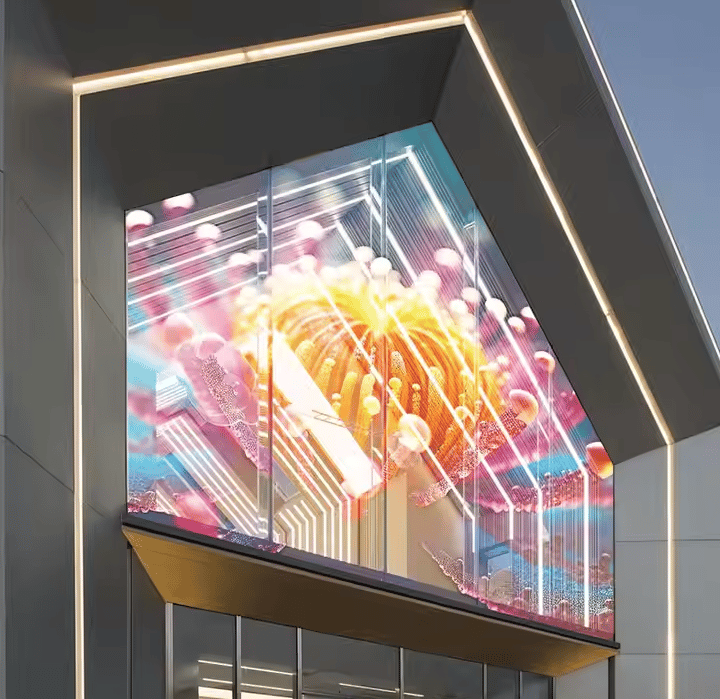
In recent years, with the rapid advancement of display technology, LED flexible film screens have gradually become a focal point in the industry. This new type of display technology, with its advantages of ultra-thin design, bendability, high brightness, and low power consumption, is revolutionizing the application scenarios of traditional display devices and unlocking new possibilities for consumer electronics, automotive displays, commercial advertising, and other fields.
The core of LED flexible film screens lies in their unique material structure and manufacturing process. Unlike traditional rigid LED displays, flexible film screens utilize bendable substrate materials such as polyimide (PI) or PET film. Through micro-level LED chip transfer technology, the light-emitting units are precisely embedded into the flexible substrate. This design not only enables the screen to bend and fold but also significantly reduces its thickness, which can be as thin as 0.1 mm or less.
Technical Advantages and Application Prospects
Compared with traditional displays, LED flexible film screens offer several significant advantages:
Ultra-Thin and Lightweight: Their thickness is only about one-tenth that of traditional LED screens, and their weight is reduced by over 70%.
Bendability: The minimum bending radius can be as small as 5 mm, allowing adaptation to various curved installations.
High Contrast Ratio: Deeper black levels and higher color saturation.
Energy Efficiency and Environmental Friendliness: Power consumption is 30–50% lower than that of traditional LEDs, with no heavy metal pollution.
These characteristics give LED flexible film screens immense potential across multiple fields. In consumer electronics, innovative products such as foldable smartphones and rollable TVs are gradually entering the market. In automotive displays, curved dashboards and adaptive center console screens enhance the driving experience. In commercial advertising, their lightweight properties can be leveraged to create creative curved billboards.
Manufacturing Processes and Challenges
The production of LED flexible film screens involves several cutting-edge technologies. The most critical among these is Mass Transfer Technology, which requires the precise transfer of millions of micro-level LED chips onto flexible substrates. Currently, the industry primarily employs three methods: stamp transfer, laser transfer, and fluid self-assembly, each with its own advantages and disadvantages.
However, the large-scale commercialization of LED flexible film screens still faces challenges. First is the cost issue—currently, low yield rates lead to high prices. Second is reliability—repeated bending may cause circuit breaks or brightness degradation. Additionally, the bending endurance of flexible packaging materials and driving ICs needs further improvement.
Market Development and Future Trends
According to predictions by market research institutions, the global LED flexible film screen market is expected to exceed $15 billion by 2025, with a compound annual growth rate of over 35%.
In the future, the development of LED flexible film screens will follow three major trends: first, moving toward higher resolutions, achieving 8K or even higher definition; second, improving stretchability to develop truly "elastic display screens"; and third, integrating with sensors to create intelligent interactive flexible display systems. With advancements in materials science and manufacturing processes, this revolutionary display technology is poised to fundamentally transform human-computer interaction.