
Is the Nighttime Brightness of LED Transparent Film Screen Adjustable?

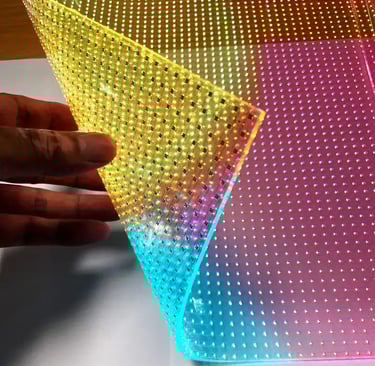
Led transparent film screens are widely used in glass display windows, glass curtain walls, commercial display facades, and creative exhibition spaces. The brightness adjustment capability at night is an important parameter for users during product selection. If the brightness of the transparent screen is too high in a nighttime environment, it may affect visual comfort, while if it is too low, it may reduce the visibility of advertising content. Therefore, whether nighttime brightness can be adjusted becomes a key evaluation criterion.
Led transparent film screens are typically equipped with built-in brightness control systems, enabling nighttime brightness management through manual settings or automatic adjustment modes. The automatic mode relies on ambient light sensors to capture light intensity, and the system adapts accordingly to maintain the screen's brightness within a suitable range at night. Users can set upper and lower brightness limits in the backend to meet the requirements of different scenarios.
Nighttime advertising displays rely heavily on content clarity and light uniformity led transparent film screens arrange light-emitting units on transparent substrates, creating a natural transition between the displayed image and ambient light, ensuring stable visual effects at night. The brightness adjustment function allows users to flexibly switch between peak-season events, daily displays, and energy-saving modes, thereby improving display management efficiency.
The adjustable nighttime brightness feature of led transparent film screens makes them suitable for commercial street display windows, shopping mall facades, multi-story glass curtain walls, and nighttime landscape projects. In practical use, users can set brightness strategies based on regional lighting requirements and crowd density, bringing the screen's brightness closer to visual comfort standards and enhancing nighttime display quality.
With their lightweight and thin structure, transparent screens enable remote brightness adjustment through the control system without complex operational procedures. In nighttime scenarios, operational teams can leverage this function for energy-saving management, reducing unnecessary energy consumption, minimizing device heat generation, and extending system stability.